
When the Strait of Hormuz became effectively impassable earlier this year, roughly a fifth of the world’s oil supply [1], including a significant share of jet fuel exports, was suddenly exposed to severe disruption. According to the International Energy Agency, Europe had maybe six weeks of jet fuel left [2]. Additionally, European jet fuel benchmarks surged by as much as 120% [3], airlines began cutting capacity, cancelling selected routes, and warning of wider disruption, while countries with only a few weeks of reserve found themselves exposed in a matter of days. It was a jarring reminder of something the aviation fuel industry has known for a long time and hasn’t always acted on.
A supply chain built around a handful of chokepoints can be easily disrupted at any time.
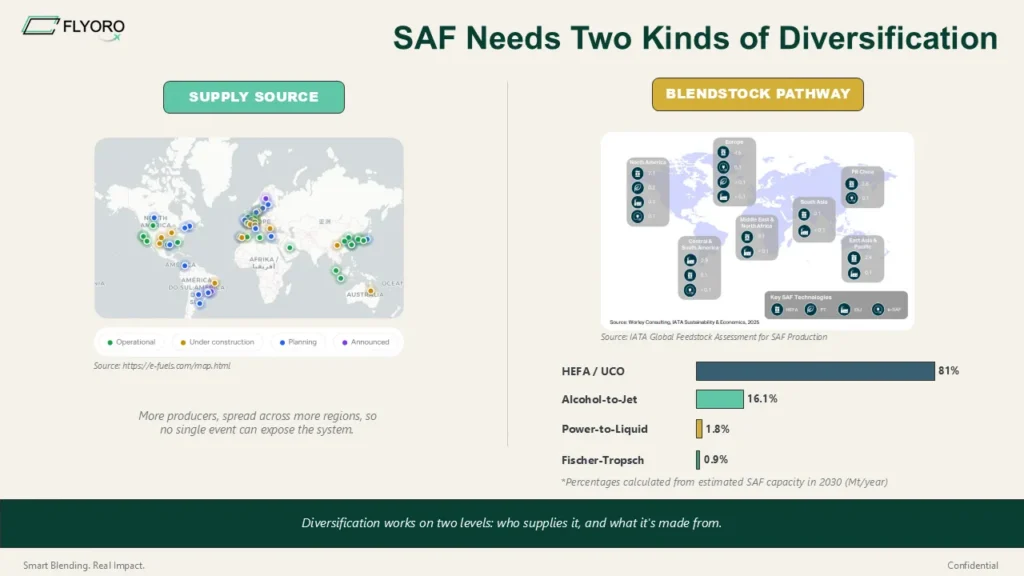
SAF Needs Two Kinds of Diversification
While conventional jet fuel benefits from decades of mature global infrastructure, the sustainable aviation fuel (SAF) ecosystem is still taking shape at scale. That gives the aviation industry a rare chance to design resilience into the system while it is still forming, rather than retrofit it later. That chance narrows every year as producers, feedstocks, and supply routes consolidate around a small number of dominant players.
Diversification for SAF has to work on two levels at once. The first is supply source: more producers, across more regions, so no single geopolitical event or logistics disruption can expose the system in the way the Hormuz crisis exposed conventional fuel. The second, less discussed, is the blendstock pathway. Used cooking oil and other HEFA feedstocks have carried most of SAF production to date [4], but leaning on one feedstock category creates the same fragility at a different layer. When that feedstock market tightens or its price moves, the entire cost base of SAF moves with it. Alcohol-to-jet, Fischer-Tropsch, and power-to-liquid pathways can help spread that exposure by widening the range of inputs, production models, and geographies available to the SAF market.
Diversification Is Both a Pricing & Resilience Strategy
Today, the common instinct is to treat diversification purely as risk management. However, it is also a cost argument.
Every point of concentration in a supply chain carries a risk premium, and that premium shows up in the price of the fuel, whether the market prices it explicitly or not.
A SAF supply chain drawing from multiple feedstocks, blendstocks and sourcing regions is better positioned to stay commercially competitive against conventional jet fuel, even as one input or one route hits turbulence.
That is also where deployment infrastructure has to keep pace.
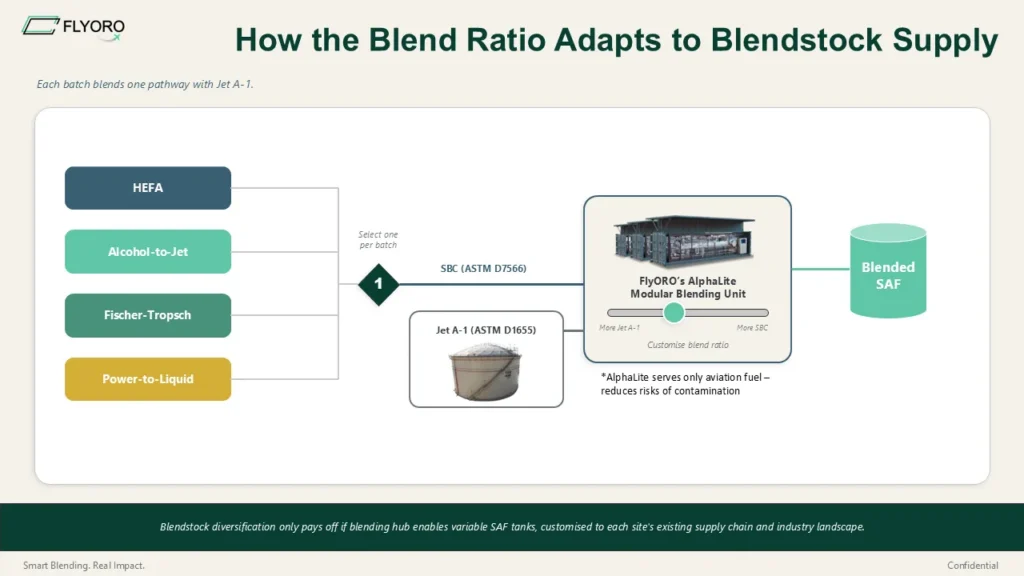
A supply chain that can diversify its inputs only matters if the blending and distribution layer can absorb that diversity.
This is the layer we spend most of our time thinking about at FlyORO. AlphaLite was built to adjust blend ratios as supply conditions shift, rather than being fixed to a single input, because infrastructure that can only take one kind of SAF, from one kind of source, defeats the purpose of feedstock diversification further up the chain.
De-risk Your Supply Chain Before It Is Tested
Hormuz was a pressure test on the conventional jet fuel supply chain, and the result was six weeks of runway and a scramble across an entire continent. SAF will be tested too, eventually, and the choices being made about supply and feedstock diversity today will determine how that goes. The key is to build a system that does not have a single point of failure baked into it, before something forces the industry to find out the hard way.
References
[2] https://www.bbc.com/news/articles/czjw2kz0l22o
[3] https://www.bbc.com/news/articles/c86d9v28qxxo
[4] https://www.iata.org/en/programs/sustainability/sustainable-aviation-fuel-saf/
About FlyORO Technologies Pte. Ltd.
FlyORO Technologies Pte. Ltd. is a Singapore-based SAF blending technology company and a pioneer in SAF blending infrastructure. Its flagship AlphaLite platform is a modular, 40-foot blending unit powered by FlyORO’s proprietary, patented technology and designed to integrate with existing fuel infrastructure, enabling SAF delivery wherever it is needed across the supply chain – upstream at production sites, midstream at fuel terminals, or downstream at airport fuel farms. This versatility allows airport fuel operators to serve customers more effectively through a simplified supply chain, while giving airlines and fuel buyers the flexibility to align SAF uptake with their sustainability commitments.
In 2025, FlyORO deployed an AlphaLite unit with Wagner Sustainable Fuels and Boeing at Toowoomba Wellcamp Airport in Queensland, Australia – the first SAF blending terminal co-located at an airport globally, a milestone that advanced AlphaLite to Technology Readiness Level 9 (TRL 9). As of 2025, FlyORO has blended more than 500,000 litres of SAF across its AlphaLite deployments.
For all commercial, marketing and investment enquiries, please contact us at hello@flyoro.co