
As Sustainable Aviation Fuel (SAF) adoption accelerates, Book and Claim mechanisms are becoming an increasingly important part of airlines’ procurement strategy. The model allows airlines and corporates to purchase the environmental attributes of SAF without requiring the physical fuel to be delivered to the airport where they operate. This has expanded access to SAF, particularly in regions where physical supply remains limited. The question now remains: Does Book and Claim reduce the need for physical SAF?
In reality, Book and Claim’s participation in SAF markets depends entirely on physical SAF being produced, blended, and delivered.
Without physical fuel entering the supply chain, there are no attributes to allocate.
Book and Claim is an Accounting Mechanism
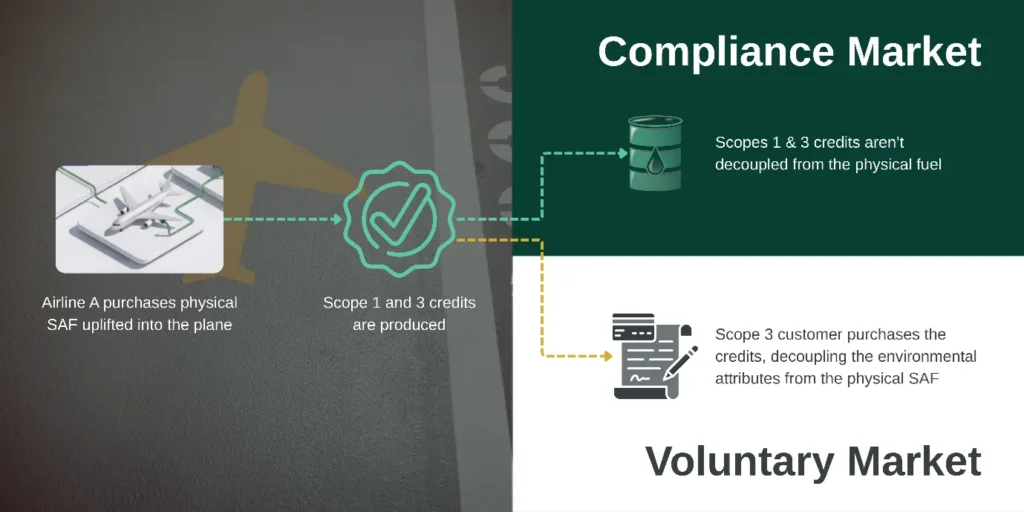
Fundamentally, Book and Claim is an accounting and attribute allocation mechanism. It allows SAF environmental attributes to be separated from the physical fuel and transferred to a different user. This system plays an important role in enabling:
- Corporate climate participation in aviation decarbonisation
- SAF procurement by airlines operating at airports without SAF access
- Early demand signals for SAF producers
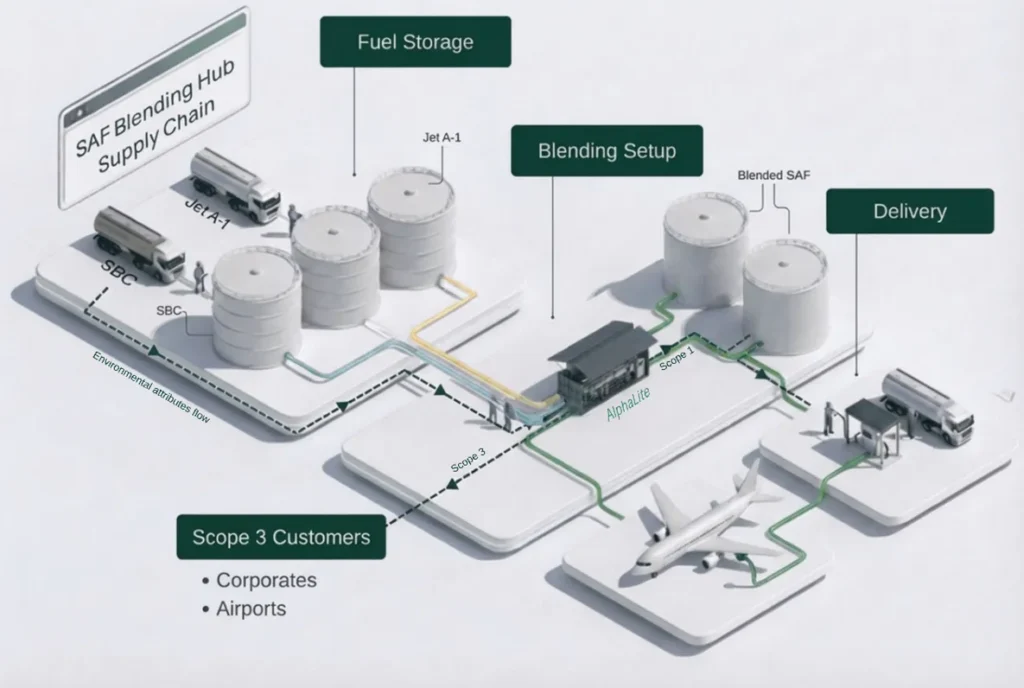
However, every Book and Claim certificate must be backed by SAF that has been produced and physically blended into the fuel system at the point of no return.
SAF Mandates Require Physical Fuel Supply
Another important factor shaping SAF adoption is the emergence of mandates. Across multiple regions, governments are transitioning SAF from a voluntary initiative into a mandatory requirement. These mandates, like the Refuel EU and UK SAF mandate, typically require fuel suppliers to demonstrate that SAF has been physically supplied into aviation fuel systems through verified supply reporting.
In compliance markets, SAF certificates do not satisfy regulatory requirements.
Fuel suppliers must ensure actual SAF supply into the fuel ecosystem and non-compliance can result in penalties. This is where the ability to integrate SAF quickly into airport fuel systems becomes critical.
Many supply chains today still face practical constraints around blending infrastructure and fuel logistics, which slows SAF deployment even when supply and policy signals are present.
Technologies such as FlyORO’s modular AlphaLiteTM blending units that can be deployed anywhere, including directly at or near airports, are designed to address this operational gap by enabling SAF to be blended onsite without requiring large-scale infrastructure upgrades. This ensures actual fuel integration on the ground.
As more jurisdictions introduce SAF mandates, the availability of physical fuel supply becomes increasingly critical.
This means that while Book and Claim expand access, physical SAF integration remains essential for regulatory compliance.
SAF Economics Still Depend on Physical Supply
Furthermore, even within Book and Claim markets, the economics of SAF are ultimately determined by how much physical fuel is available. When SAF production and blending capacity remain limited:
- SAF premiums remain high
- Book and Claim certificates become expensive
- Market participation becomes restricted
However, as more SAF is produced and blended into airport fuel farms, supply increases and SAF premiums begin to stabilise as economies of scale are achieved. As a result, Book and Claim credits become more affordable.
By increasing physical blending capacity within the supply chain, this process can be accelerated.
Modular systems like the AlphaLite allows SAF to be integrated easily and this provides a faster pathway to increasing SAF supply, thus lowering the barrier to SAF adoption across the entire ecosystem.
Aviation Energy Security and SAF Supply Diversification
Lastly, recent geopolitical tensions in the Middle East, including disruptions around the Strait of Hormuz, have once again highlighted the fragility of global jet fuel supply chains. One-fifth of the world’s oil supply, equating to approximately 20 million barrels of petroleum and crude oil, flows through this narrow shipping corridor. When disruptions occur, the impact can ripple across global energy markets, affecting fuel prices, supply stability, and operational planning for industries such as aviation.
While SAF is often discussed primarily through the lens of decarbonisation, it also offers an important opportunity to improve aviation fuel supply resilience.
Unlike conventional jet fuel, which is heavily tied to crude oil supply routes and refining hubs, SAF production pathways can be geographically distributed.
Feedstocks, refining technologies, and blending infrastructure can be developed across multiple regions, enabling aviation fuel supply to become less dependent on global chokepoints.
The Future of SAF Requires Both Market Mechanisms and Physical Infrastructure
In short, Book and Claim mechanisms will continue to play an important role in expanding SAF participation and mandates will continue to create stronger demand signals. However, every SAF certificate still traces back to physical fuel moving through the aviation infrastructure. As aviation works toward both decarbonisation and energy resilience, the industry’s challenge is ensuring that the fuel can be physically integrated into airport operations at the pace required. Ultimately, scaling SAF adoption will depend not only on policy frameworks and market mechanisms, but also on the infrastructure that allows fuel to move through the system.
About FlyORO Technologies Pte. Ltd.
FlyORO Technologies Pte. Ltd. is a Singapore-based SAF blending technology company and a pioneer in SAF blending infrastructure. Its flagship AlphaLite platform is a modular, 40-foot blending unit powered by FlyORO’s proprietary, patented technology and designed to integrate with existing fuel infrastructure, enabling SAF delivery wherever it is needed across the supply chain – upstream at production sites, midstream at fuel terminals, or downstream at airport fuel farms. This versatility allows airport fuel operators to serve customers more effectively through a simplified supply chain, while giving airlines and fuel buyers the flexibility to align SAF uptake with their sustainability commitments.
In 2025, FlyORO deployed an AlphaLite unit with Wagner Sustainable Fuels and Boeing at Toowoomba Wellcamp Airport in Queensland, Australia – the first SAF blending terminal co-located at an airport globally, a milestone that advanced AlphaLite to Technology Readiness Level 9 (TRL 9). As of 2025, FlyORO has blended more than 500,000 litres of SAF across its AlphaLite deployments.
For all commercial, marketing and investment enquiries, please contact us at hello@flyoro.co